Halal Analyzed 🌱 Quality Reviewed

Know What's Really
In Your Food

Ingredient-level analysis · Quality scored · Source-cited

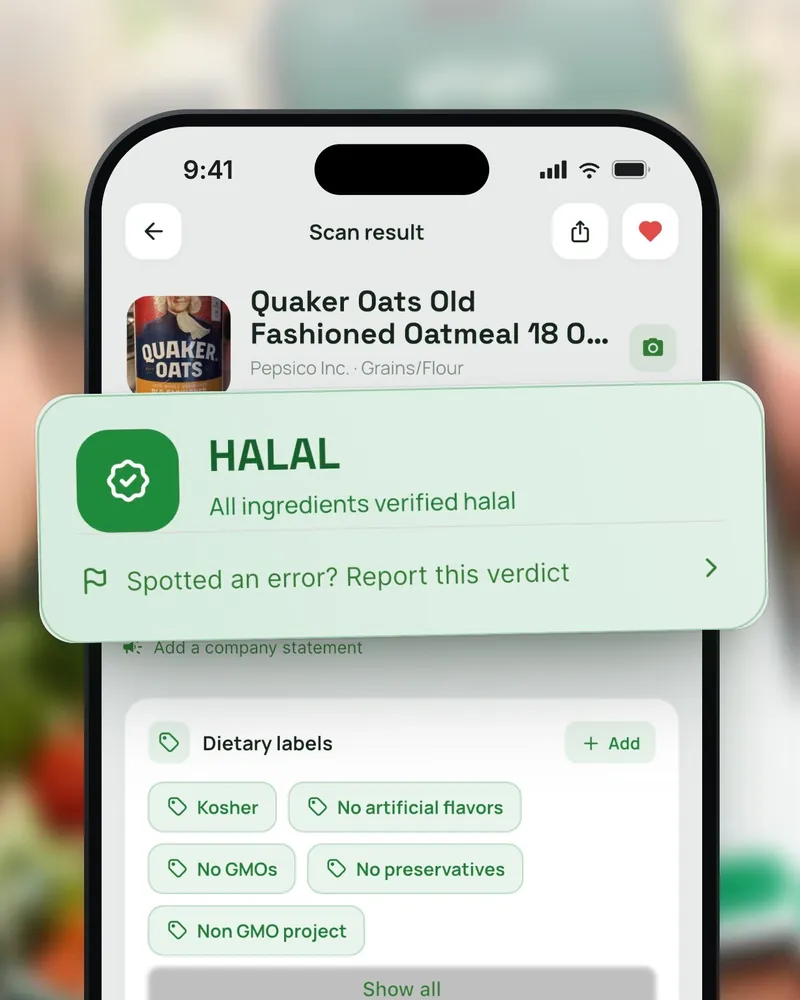
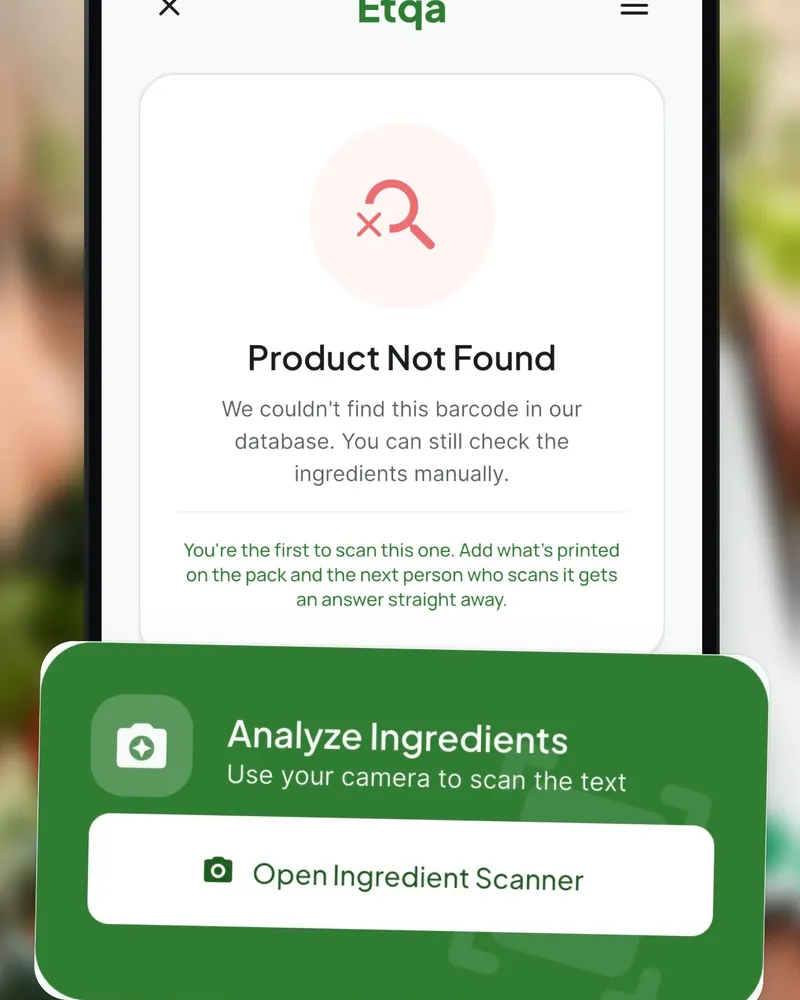
Scan any food product and get an instant, clear verdict on every ingredient — halal status, hidden additives, artificial flavors, and E-numbers — backed by cited Islamic and food safety sources.

Launching soon — get notified at launch →

All Halal
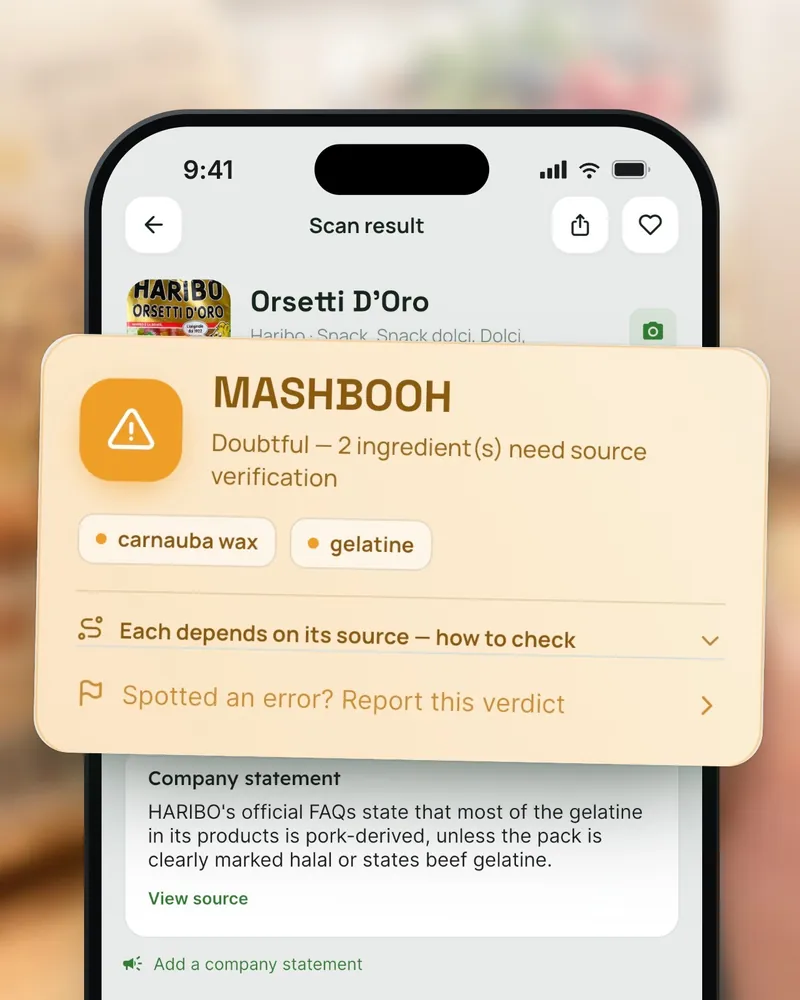
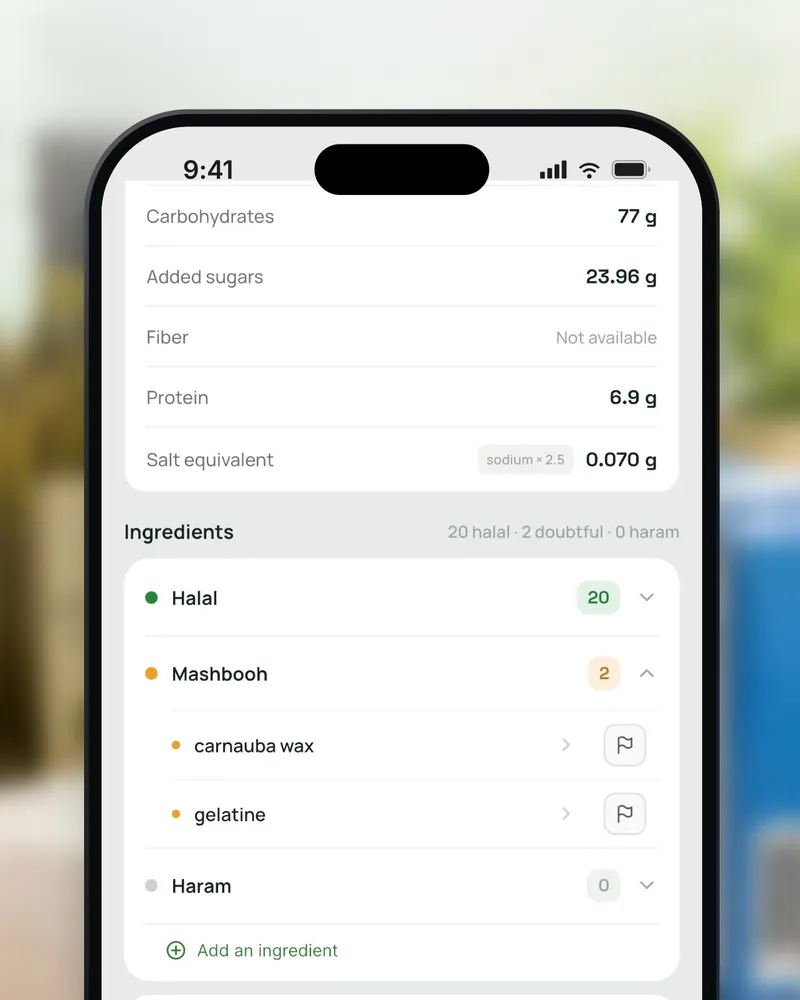
Mashbooh — Verify!
Trans Fat Found
ETQA
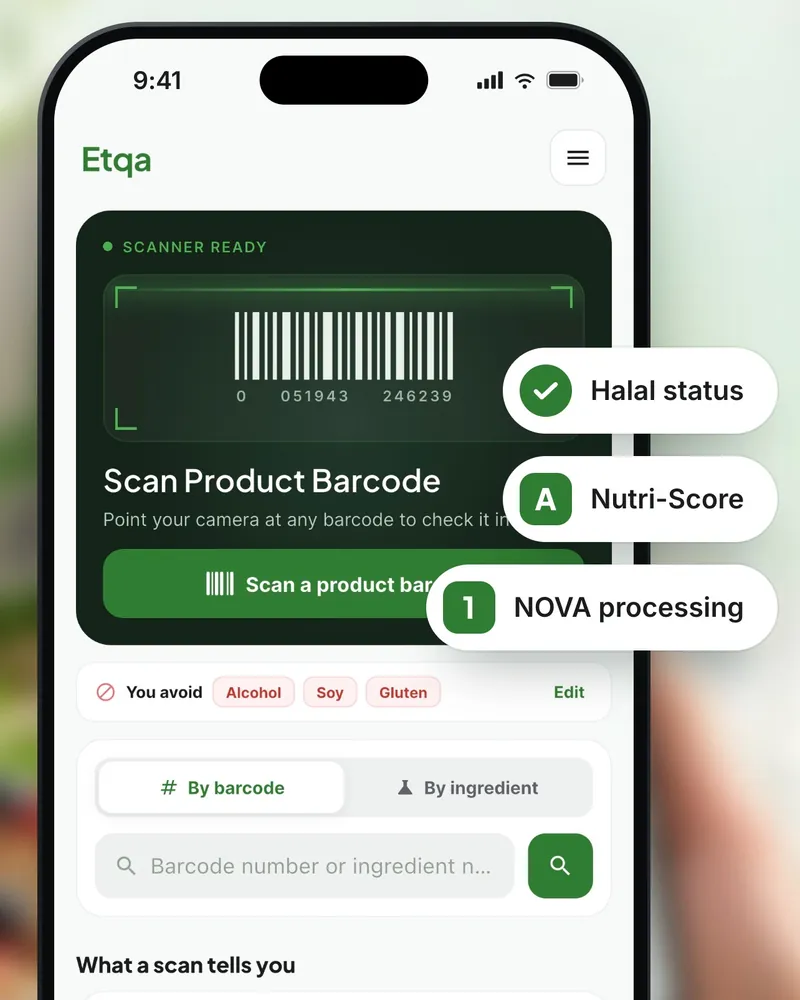
Scan Product Barcode
Point your camera at any barcode
Scan a product
Ingredient Analysis
Analysis Complete
Vanilla Bean
Flavoring agent / Spice
Halal ✓
E471 Emulsifier
Source unclear — verify
Mashbooh ?
14 Halal
0 Haram
2 Mash.
1M+
Products in Database
3,000+
Additives Decoded
200+
EU-Restricted Items Flagged
Cited
Islamic & Food Safety Sources

The Hidden Truth Behind Modern Food

Most packaged food carries a story the label won't tell you. Here's what's actually happening on supermarket shelves today.

~60%
Of Daily Calories

In the US and most Western diets, the majority of daily calories now come from ultra-processed foods — engineered for shelf life and taste, not health.

30+
Avg Ingredients

The average packaged product contains over 30 ingredients — many you can't pronounce, half of which weren't in food fifty years ago.

100+
Behind "Natural Flavor"

"Natural flavor" is a regulatory loophole. A single label term can hide dozens of synthesized compounds — animal-derived, alcohol-extracted, or lab-engineered.

200+
EU-Banned, US-Legal

Hundreds of additives banned or restricted in the European Union remain perfectly legal in the United States — including artificial colors and preservatives.

Why It Matters

Real Impact, Every Time You Eat

ETQA isn't just a label decoder. It's a tool for protecting what matters most — your faith, your health, and the people you feed.

For Your Faith

Eat with a Clear Conscience

Living a faith-conscious life shouldn't mean spending twenty minutes decoding every label. ETQA verifies every ingredient — including the hidden ones — so your daily rizq aligns with your beliefs without guesswork.

  • Peace of mind in any supermarket, anywhere in the world
  • Confidence when traveling or eating abroad
  • A trusted helper for raising mindful children
For Your Body

Reduce What Doesn't Belong

Many additives still legal in your supermarket have been linked to chronic disease, hormonal disturbance, and gut microbiome disruption. ETQA surfaces every flagged ingredient so you can choose with full information — not blind trust.

  • Spot trans fats, nitrites, and synthetic preservatives
  • Identify ingredients banned in other countries
  • Avoid the additives behind ultra-processed food
👨‍👩‍👧
For Your Family

Protect the People You Love

Children eat more food per pound of body weight, and their developing systems are more sensitive to additives. Make every snack decision in seconds — even the unfamiliar brand your kid pulls off the shelf.

  • Built with children's exposure thresholds in mind
  • Flag artificial dyes linked to behavioral effects
  • Build a personal "yes list" of trusted products
Features

Everything You Need to Eat with Confidence

ETQA gives you full visibility into what you're eating — so every choice you make aligns with your faith and values.

📷

Instant Barcode Scanning

Scan any food product barcode and receive a complete ingredient-by-ingredient halal verdict in seconds. Works with over one million products.

☪️

Halal / Haram / Mashbooh

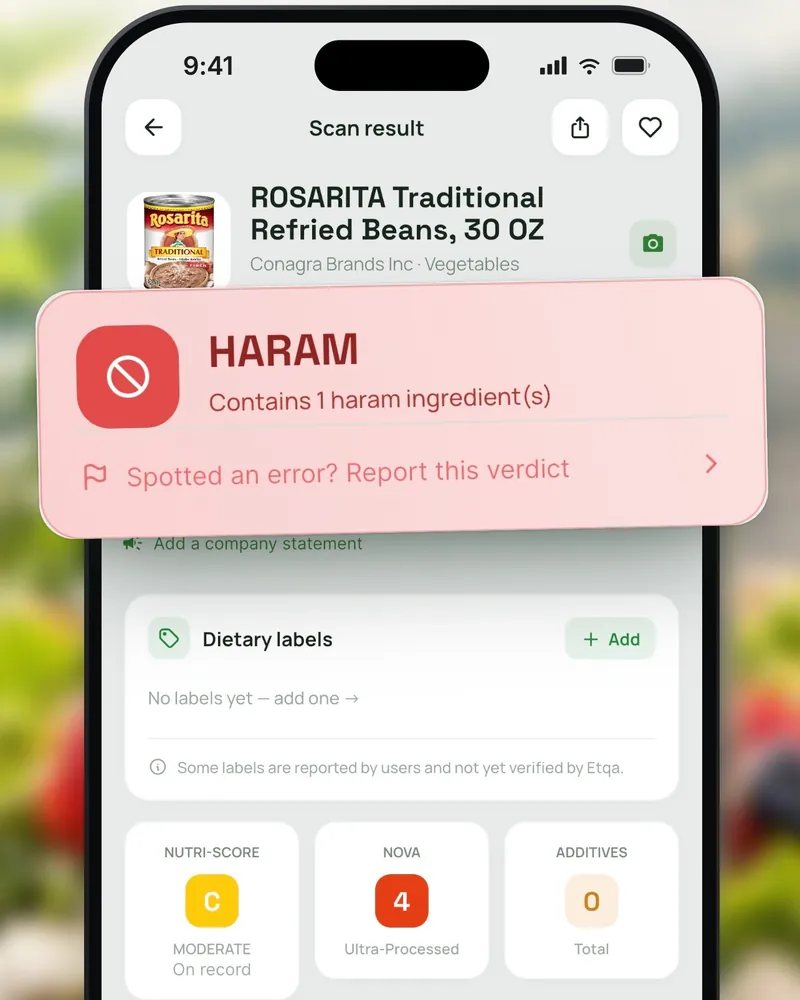
Every ingredient is clearly labeled — halal, haram, or mashbooh — so you always know exactly where each item stands before you buy.

🔢

E-Number Analysis

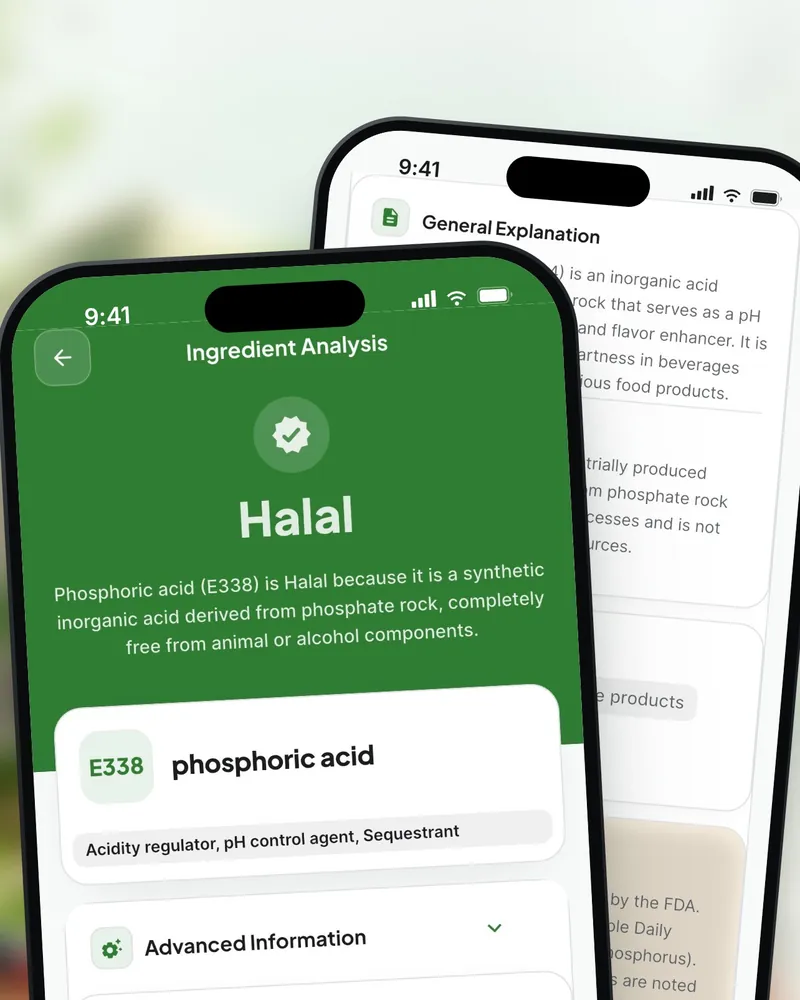
E-numbers decoded. ETQA identifies every food additive code, reveals its origin, and tells you whether it is permissible under Islamic dietary law.

🤖

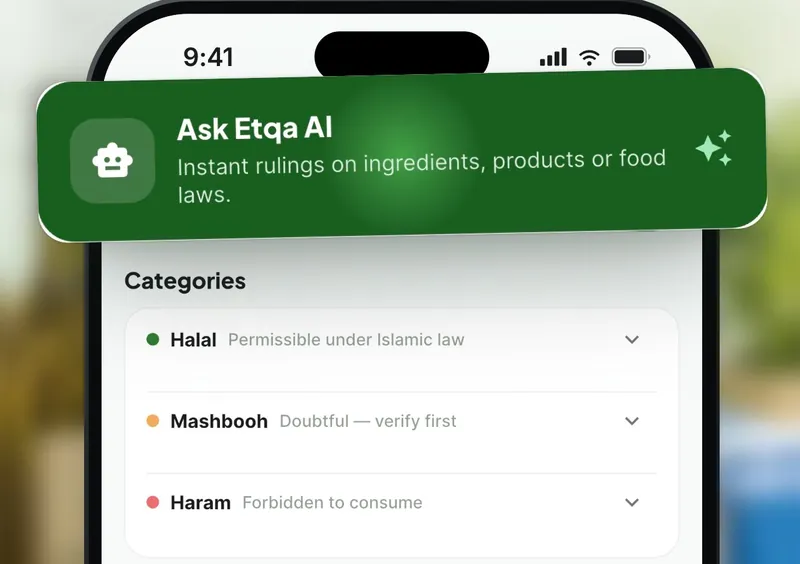
Ask Etqa AI

Have a question about an ingredient or ruling? Ask Etqa AI — your personal Islamic dietary assistant — and get a sourced answer from cited scholarly references.

📖

Islamic Dietary Guide

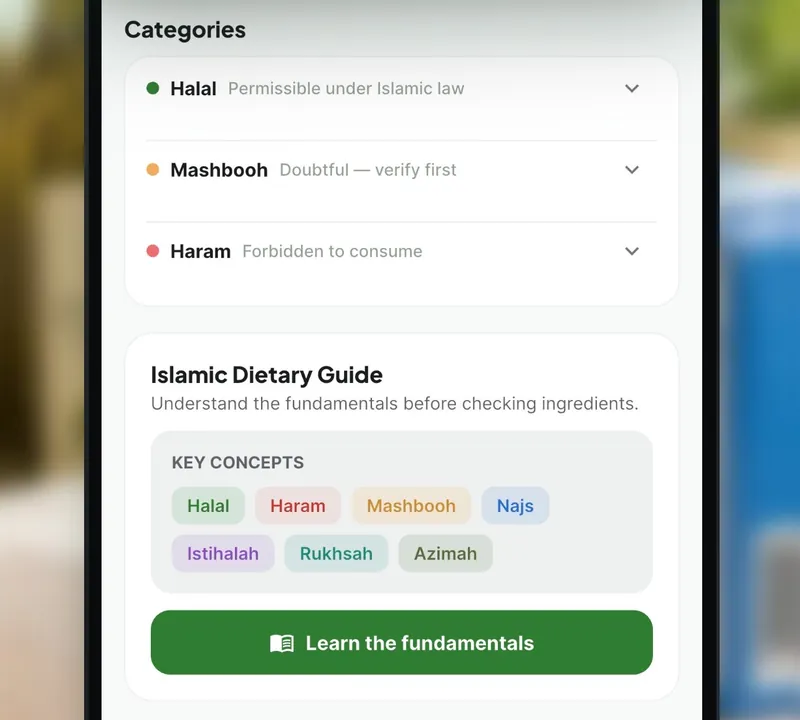
Built-in educational content covering the fundamentals of halal food law, key concepts like Istihalah and Rukhsah, and common misconceptions — all in one place.

📚

Cited & Verified Sources

Every ruling is traceable. ETQA cites authoritative Islamic scholarly references and regulatory bodies so you can verify any classification yourself.

In Your Hands

Real Life with ETQA

Five seconds at the shelf instead of fifteen minutes on Google. Here's where ETQA earns its place in your daily life.

🛒

At the Supermarket

Scan unfamiliar brands without leaving the aisle. No more deciphering microscopic ingredient lists or searching for E471 with one hand.

✈️

Traveling Abroad

Foreign-language label? ETQA reads the barcode, not the text — so it works the same way whether you're in Istanbul, Toronto, or Jakarta.

🍼

Shopping for Kids

Snacks marketed to children are often the most processed. ETQA flags hidden dyes, sweeteners, and additives most likely to affect young bodies.

🌙

During Ramadan

Iftar prep involves enough decisions. Verify every ingredient for suhoor, iftar, and gifts — without slowing down the household.

✦ Ask Etqa AI

Your Personal Islamic Dietary Assistant

Not sure about an ingredient? Ask Etqa AI anything — from whether a specific E-number is halal, to how Islamic schools of thought differ on a ruling. Clear, sourced answers, instantly.

Get Early Access
Etqa AI
● AI Dietary Assistant
Assalamu Alaikum! I can help you analyze ingredients and understand Islamic dietary rulings.
Is E471 halal?
How It Works

Three Steps to Clarity

From scan to verdict in seconds.

01

Scan the Barcode

Open ETQA and point your camera at any food product barcode — or type the barcode number manually. The product is identified instantly.

02

Every Ingredient is Analyzed

ETQA checks each ingredient against its curated halal database, classifying it as halal, haram, or mashbooh — including all E-numbers and processing aids.

03

Get Your Report

Receive a clear, color-coded report with the halal verdict for every ingredient, flags for anything questionable, and cited references — all in seconds.

Total Food Transparency

We built ETQA for Muslims who want certainty — but the same lens that catches haram ingredients catches everything else, too. Every additive. Every artificial flavor. Every hidden source.

🧪

Artificial Flavors Detected

Spot synthetic flavors hidden behind generic labels like "natural flavor" or "flavoring." ETQA tells you what's real and what's lab-made.

⚗️

Hidden Additives Exposed

Preservatives, stabilizers, emulsifiers, anti-caking agents — every additive explained in plain language, not chemistry textbook jargon.

🔢

Every E-Number Decoded

From E100 to E1525 — instantly know what each food code means, where it comes from, and whether it's plant-based, animal-derived, or synthetic.

🌱

True Source Origin

Plant, animal, microbial, or chemically synthesized? ETQA reveals where each ingredient really comes from — not just what it's called.

⚠️

Allergen & Sensitivity Flags

Common allergens — nuts, dairy, soy, gluten, sulfites — flagged at a glance so you don't have to scan ingredient lists line by line.

🏷️

Processing Level Insight

Spot ultra-processed ingredients and understand the difference between whole-food, minimally-processed, and heavily-engineered ingredients.

Watch List

Ingredients ETQA Flags Closely

Beyond halal compliance, ETQA flags ingredients with documented health, safety, or regulatory concerns — so you can make informed choices for yourself and your family.

⚠️

Artificial Sweeteners

Aspartame · Sucralose · Saccharin

Synthetic sweeteners linked to gut microbiome disruption and metabolic concerns in recent WHO advisories. Common in diet sodas, sugar-free gum, and "lite" yogurts.

WHO advisory: Not recommended for weight control (2023)
🎨

Synthetic Food Colors

Red 40 · Yellow 5 · Yellow 6 · Blue 1

Petroleum-derived dyes linked to hyperactivity in children. Required to carry warning labels in the EU, and increasingly restricted at the US state level.

Restricted in: EU, UK, California (2027)
🚫

Trans Fats

Partially Hydrogenated Oils

The most clearly harmful fat in the food supply — directly linked to cardiovascular disease. Banned in many countries, but trace amounts persist in some products.

Banned in: EU, US (2018), Canada, India
🧪

Synthetic Preservatives

BHA · BHT · TBHQ

Petroleum-derived preservatives used to extend shelf life. Listed by the US National Toxicology Program as "reasonably anticipated to be a human carcinogen."

Restricted in: EU, Japan, parts of Australia
🥩

Sodium Nitrite / Nitrate

Cured Meat Preservative

Used to cure deli meats, bacon, and hot dogs. Forms nitrosamines during cooking — classified by the WHO's IARC as Group 1 carcinogenic to humans when consumed via processed meat.

WHO IARC: Group 1 carcinogen (processed meat)

Titanium Dioxide

E171 · Whitening Agent

White pigment used in candies, gums, and dairy desserts. Banned across the European Union after EFSA could no longer consider it safe due to genotoxicity concerns.

Banned in: European Union (2022)

What Europe Banned, America Still Sells

The US and EU regulate food additives under fundamentally different philosophies. Hundreds of ingredients restricted or outright banned in European food remain perfectly legal on US shelves today.

🇪🇺
European Union

Precautionary Principle

When credible scientific concern exists about an additive, EU regulators restrict or ban it until proven safe. The burden of proof falls on industry to demonstrate harm-free use.

🇺🇸
United States

"Generally Recognized as Safe"

Many additives reach US shelves through self-affirmed GRAS — where companies (not the FDA) determine an additive's safety. The burden of proving harm falls on regulators after public exposure.

Ingredient
🇪🇺 European Union
🇺🇸 United States
Titanium DioxideE171 — whitening agent in candy, gum, dairy
Banned 2022 · EFSA genotoxicity concerns
Allowed
Brominated Vegetable OilBVO — citrus-flavored sodas and drinks
Banned For decades
FDA banned August 2024 — decades after EU
Potassium BromateFlour treatment — commercial bread
Banned
Allowed
AzodicarbonamideADA — bread dough conditioner ("yoga mat" chemical)
Banned
Allowed
Red Dye No. 3Erythrosine — candies, baked goods
Restricted
FDA banned Jan 2025 — phase-out through 2027
rBGH / rBSTBovine growth hormone in dairy production
Banned
Allowed
BHA / BHTSynthetic preservatives — cereals, snacks, gum
Heavily restricted
Widely allowed
Yellow No. 5 & 6, Red 40Petroleum-derived synthetic dyes
Warning label required Hyperactivity link in children
No warning required

The Smallest Bodies Carry the Biggest Burden

Children are not small adults. They eat more food per pound of body weight, their organs are still developing, and their additive exposure compounds across years of consumption. The food marketed most aggressively to them is, too often, the food carrying the most red flags.

3–4×
Higher Exposure

Per pound of body weight, a child can consume several times the additive load of an adult eating the same product. Developing systems absorb more, filter less, and have less margin for error.

EU
Warning Labels Required

Following the UK's landmark Southampton study, the EU mandates hyperactivity warning labels on Red 40, Yellow 5, Yellow 6, and other synthetic dyes — still freely used and unlabeled in many US snacks.

Top Aisles
The Most Affected

Bright candies, sweetened cereals, flavored drinks, and "kid-friendly" packaging consistently show up among the most additive-heavy categories — exactly where small hands reach first.

What ETQA Watches For — On Your Behalf

Synthetic food dyes (Red 40, Yellow 5/6, Blue 1)
High-fructose corn syrup and hidden sugars
Artificial sweeteners (aspartame, sucralose)
Petroleum-based preservatives (BHA, BHT, TBHQ)
"Natural flavor" loopholes and undisclosed extracts
Allergen flags and ingredient sensitivities
Methodology

How We Evaluate Food Quality

ETQA layers multiple internationally-recognized food quality scoring methods alongside its halal analysis — so every product is evaluated from several angles, not just one.

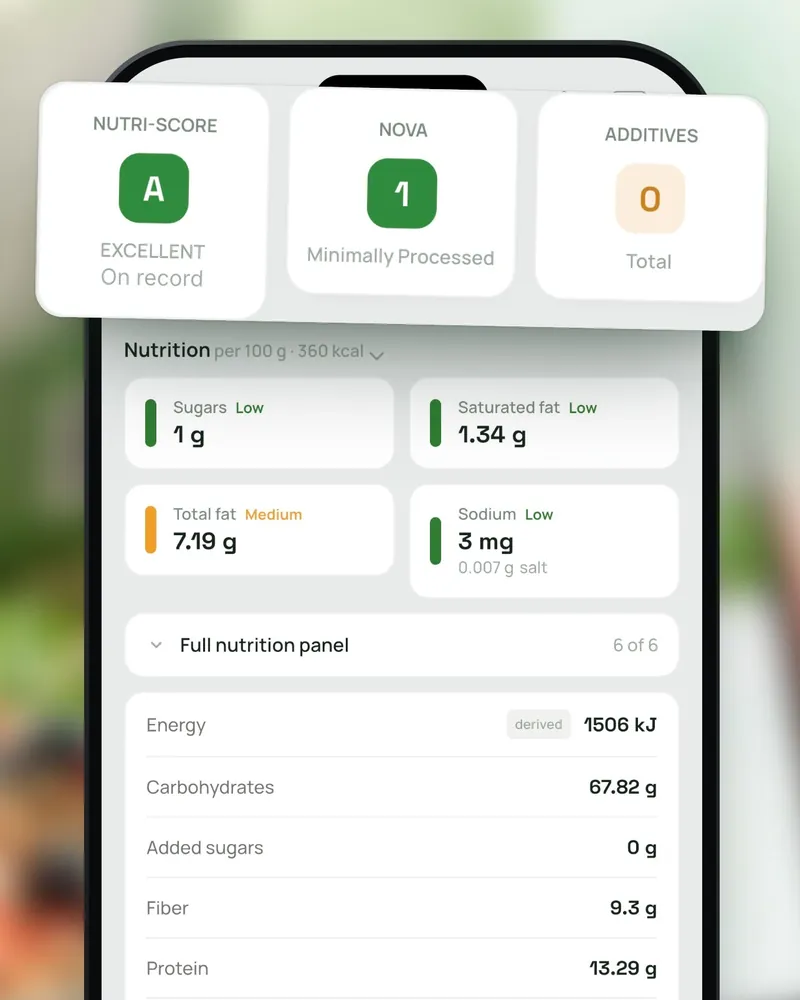
NOVA Classification

Processing-level framework developed at the University of São Paulo. Used by the WHO, PAHO, and national health agencies worldwide.

1
2
3
4
Unprocessed Ultra-processed

NOVA classifies foods by how much they've been industrially processed — from Group 1 (whole foods like fruit, vegetables, milk) to Group 4 (ultra-processed sodas, snacks, processed meats). Group 4 foods are linked to higher risk of obesity, cardiovascular disease, and metabolic disorders.

Nutri-Score

Front-of-pack nutritional grading. Officially adopted in France, Germany, Belgium, Spain, the Netherlands, and Switzerland.

A
B
C
D
E
Most nutritious Least nutritious

Nutri-Score grades foods from A (most nutritious) to E (least nutritious), based on energy density, sugar, saturated fat, and sodium — balanced against fiber, protein, and the presence of fruits, vegetables, or legumes. The grade you'd see on packaging across most of Europe.

ETQA Halal Analysis

Our own ingredient-level review. Built on classical fiqh references and contemporary halal scholarly guidance — every classification cited and verifiable.

Halal
Mashbooh
Haram
Permitted Forbidden

Each individual ingredient — not the product as a whole — is analyzed against scholarly sources. ETQA does not certify products; it gives you the analysis so you can decide for yourself, with citations attached to every ruling.

Islamic Classifications

Understanding the Three Categories

ETQA applies the core Islamic dietary classifications to every ingredient in every product you scan — clearly and consistently.

Halal
حلال — Permissible

Lawful and permitted by Islamic law. These ingredients are fully cleared for Muslim consumption and confirmed across major schools of thought.

Fruits & vegetables Halal-slaughtered meat Fish with scales
Haram
حرام — Forbidden

Strictly forbidden by Islamic law. These ingredients are prohibited regardless of quantity or how they appear on the label.

Pork & derivatives Alcohol Blood products
?
Mashbooh
مشبوه — Questionable

Ingredients whose source or processing is unclear or disputed. ETQA flags these so you can make an informed decision or seek further guidance.

Gelatin (unknown source) Some E-numbers Unclear enzymes
Common Questions

Questions People Ask Us

Honest answers about how ETQA works and what makes it different.

Is "natural flavor" actually natural? +
Not necessarily. Under both US and EU regulations, "natural flavor" can include dozens of compounds — some plant-derived, some animal-derived, some extracted using alcohol or chemical solvents. The label tells you almost nothing about what's actually inside. ETQA works to identify the likely source whenever possible and flags ingredients where the source matters for halal status or food safety.
Why does ETQA flag ingredients that aren't haram? +
Because Islamic dietary guidance values overall wellbeing — your body is an amanah (trust). An ingredient can be technically halal yet still concerning for health, like trans fats or certain artificial dyes. ETQA gives you both layers of information so you can make a fully informed choice. The halal verdict is always primary; the health flags are supplementary.
How is ETQA different from other food-scanning apps? +
ETQA combines halal-first ingredient analysis with established food-quality frameworks. Most apps focus on one dimension — health scores, allergens, or just halal certifications. ETQA layers them together: ingredient-level halal analysis (with citations), NOVA processing classification, Nutri-Score nutritional grading, and watchlist flags for problematic additives. Importantly, ETQA does not certify products as halal — it analyzes them ingredient by ingredient and shows you the sources behind every ruling, so you can verify yourself.
What schools of thought does ETQA reference? +
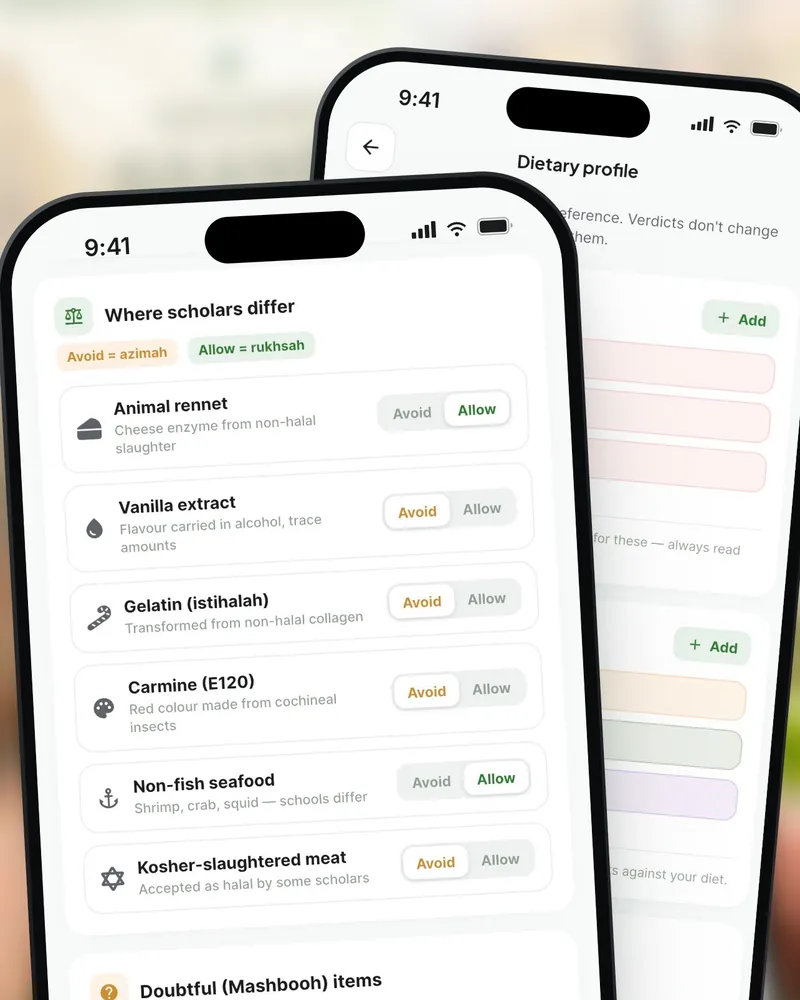
ETQA references rulings from across the major Sunni schools (Hanafi, Maliki, Shafi'i, Hanbali) and notes where the schools differ on specific ingredients. Where scholars disagree, ETQA shows the range of opinions rather than picking one — and flags the ingredient as Mashbooh (questionable) so you can follow your own scholarly tradition.
Why are some additives banned in Europe but allowed in the US? +
The two regulators use different frameworks. The European Union applies the precautionary principle — if there's reasonable doubt about safety, the additive is restricted until proven safe. The US FDA largely uses a "GRAS" (Generally Recognized As Safe) system that allows manufacturers to self-certify many ingredients. The result: hundreds of items flagged or banned in the EU remain in everyday US products. ETQA flags these regardless of which country you're scanning in.
What sources does ETQA cite? +
For halal rulings: classical fiqh sources, contemporary scholarly fatwas, and recognized halal certification body guidance. For food safety: the World Health Organization, the US FDA, the European Food Safety Authority (EFSA), Codex Alimentarius / JECFA, and peer-reviewed nutritional research. Every ingredient classification in the app shows you exactly which source the ruling came from.
Will ETQA work outside the US? +
Yes — ETQA's product database includes barcodes from major markets across North America, Europe, the Middle East, Southeast Asia, and beyond. Coverage is strongest in regions with widely available barcode data, and we're continuously expanding. If you scan a product we don't recognize, you can also look up any ingredient by name directly.
Powered by Trusted Authorities
WHOWorld Health Org.
FDAUS Food & Drug
EFSAEuropean Food Safety
CodexAlimentarius / JECFA
Islamic ScholarsClassical & Contemporary

Be the First to Know What's In Your Food

Join the early access list and get notified when ETQA launches on iOS and Android.

Request Early Access
Or get notified on launch